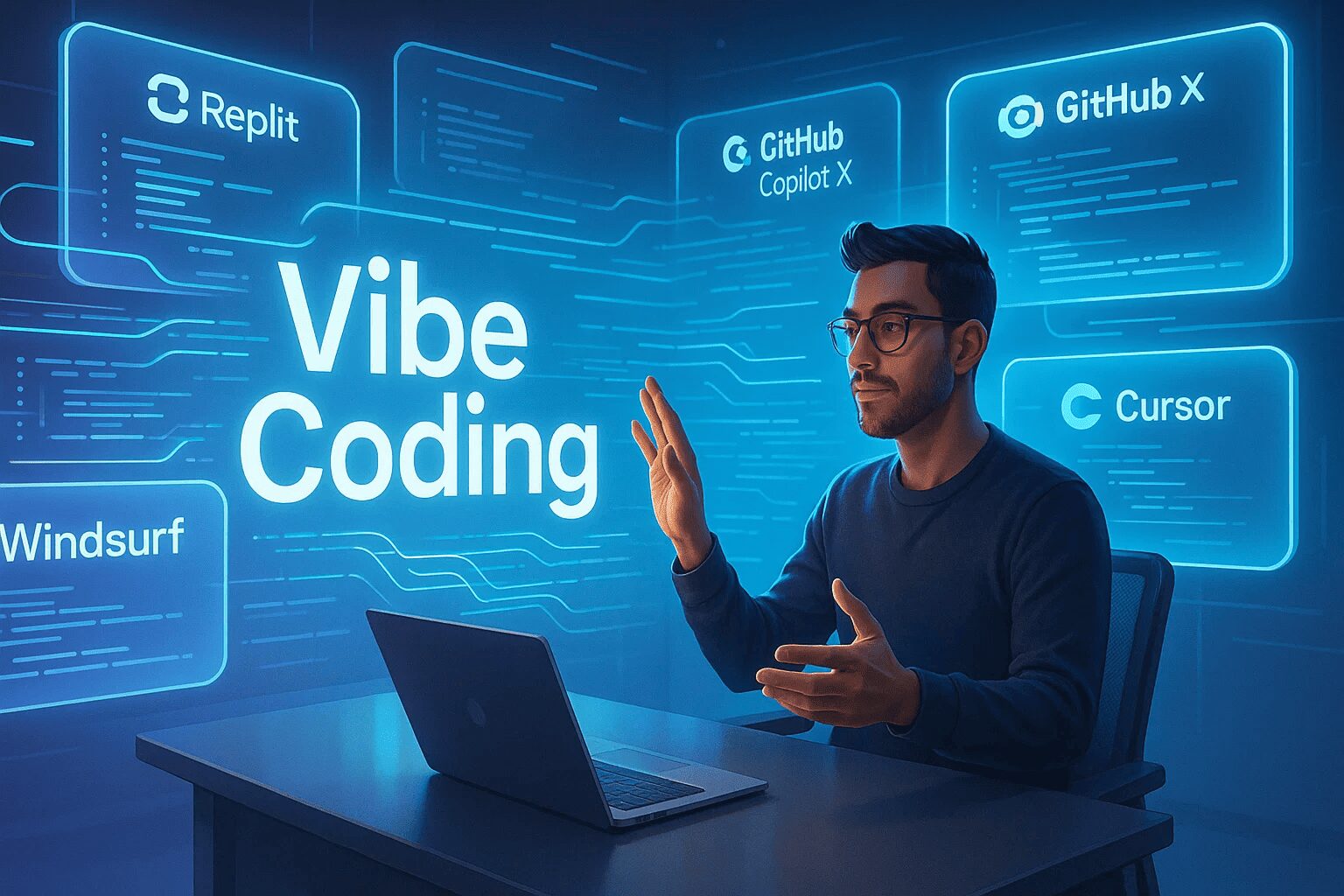
What is Vibe coding?
Over the decades, software development has gradually kept evolving, but nothing like in the past couple of years, thanks to artificial intelligence. Nowadays, AI is no longer just automating tasks; it shapes how software is actually built from the very beginning. This is giving rise to new software development methodologies, and one of the most innovative among them is Vibe Coding.
Vibe coding in software development is an AI-assisted approach in which developers express their requirements in natural language, and AI generates the functional code. Instead of writing syntax from scratch, developers simply “describe the vibe” or intention of the feature, and the AI handles the technical output.
This development style is increasingly favored by startups, product designers, frontend developers, and even enterprise teams looking to accelerate the prototyping phase by reducing repetitive coding tasks. As AI becomes increasingly powerful and accessible, vibe coding is emerging as a future-friendly workflow that blends creativity, speed, and smart automation.
What Is Vibe Coding?
Vibe Coding is a new, AI-first way to develop where you describe a feature in everyday language, and AI writes the foundational code. You iterate and refine through conversation-like prompts.
Instead of hours spent writing boilerplate code, debugging minor syntax issues, or setting up repetitive structures, a developer focuses on the following:
- What the feature should do
- How the user should experience it
- What the final output should feel like
AI performs the tasks of writing initial code, suggesting improvements, and carrying out repetitive work. Humans retain control over decisions, testing, and quality assurance.
In other words, vibe coding enables developers to be more productive by thinking more and typing less.
How Vibe Coding Works
Although the idea is simple, vibe coding relies on a carefully structured AI-generated code workflow:
Natural Language Prompts
Developers start by describing a feature:
- Develop a login page with email, password, forgot password link, and validation.
- Generate a RESTful API endpoint for creating new orders.
- Make a responsive hero section with animation and a CTA button.
AI interprets the intent and turns it into functional code.
AI Code Generation
This is where the magic happens.
AI tools like ChatGPT, GitHub Copilot, Replit Agents, or custom LLM-powered systems get them the runnable code in seconds. The output might include:
- HTML/CSS/JS components
- API routes
- Database schemas
- Flutter or React Native screens
- Backend logic
- Integration guidelines
Iteration + Refinement
After this initial output, the developers refine by prompting:
- Add error handling.
- Make the UI more minimal.
- Add dark mode.
- Optimize the query.
The process repeats itself until the code is as desired.
This iterative prompting is the core strength of vibe coding; it enables developers to make adjustments in seconds rather than manually reworking large portions of code.
Why Developers Are Adopting Vibe Coding
Vibe coding aligns with the way the modern tech world works: fast, flexible, and fluid. Here’s why it’s becoming widely adopted:
Faster Prototyping
Ideas can be transformed into working prototypes in hours, rather than weeks.
Startups, students, freelancers, and innovation labs can:
- Quick ideas validation
- Launch MVPs faster
- Reduce development cycles
Lower Entry Barrier
Beginners who struggle with syntax feel empowered because they can express requirements naturally. Even non-developers, such as product managers, designers, and founders, can participate in early development.
More Emphasis on Logic rather than Syntax
Instead of stressing over:
- Semicolons
- Import paths
- Boilerplate setup
- Routing configs
Developers get to focus on logic, experience, and problem-solving.
AI-Augmented Creativity
AI helps developers explore ideas, patterns, and structures that they might not have otherwise considered. It can be a brainstorming partner.
Core Principles of Vibe Coding
The following are four guiding principles to be followed by a developer for effectively using vibe coding:
Clarity of the Prompt
Clear descriptions lead to better code.
Instead of saying this:
“Make a UI.”
Say: “Create a mobile-first UI that includes a top navbar, search bar, three product cards, and a footer using a clean, modern layout.
More clarity gives better output.
Human Oversight
AI might create impressive code, but humans have to:
- Review logic
- Test functionality
- Catch security issues
- Ensure performance
AI helps, yet does not replace responsibility.
Continuous Testing
Every generated component should be tested, especially in production use. Testing ensures:
- No broken dependencies
- No unexpected behaviors
- No UI inconsistencies
Safe Deployment
Before a vibe-coded project goes live:
- Audit the code
- Validate data handling
- Comply with
- Optimize performance
Responsible development still matters; AI just accelerates the workflow.
Tools & Platforms that Enable Vibe Coding
Modern tools powered by AI make vibe coding possible. Some major categories include:
AI Code Assistants
- ChatGPT
- Claude
- GitHub Copilot
- Codeium
These tools convert natural prompts into code.
IDE Integrations
Extensions for VS Code and plugins for JetBrains make vibe coding easy right within your development environment.
Prompt-Based Frameworks
Some frameworks are designed with integration to AI:
- Replit’s AI Agents
- Cursor Editor
- Bolt.new
- AI-powered low-code platforms
These tools help developers build apps almost entirely through prompts.
Vibe Coding Workflow: Step-by-Step
The following is the traditional workflow of AI-generated code used by teams:
- Describe
Define in clear, natural language what you want.
- Create
AI generates initial code, layout, or structure.
- Review
Developers review everything for logical, security, and correctness issues.
- Test
Run the code, debug issues, and refine functionality.
- Enhance
Iterate using new prompts until the final product feels right.
This loop is quicker and more flexible compared to traditional coding.
Real-World Use Cases
Vibe coding isn’t mere theory-it is applied in operation.
Startups
Great for building MVPs when time and budget are limited.
Solo Developers
Single-person developers can build features that previously required a team.
UI/UX Teams
Designers can create code components for prototypes or design systems.
Fast MVP Development
Founders can validate ideas before hiring a full team.
Benefits of Vibe Coding
Speed
Vibe coding has significantly sped up the development process. What used to take hours, such as setting up UI components, writing API endpoints, or integrating databases, can be done in minutes with Vibe. This will enable teams to rapidly prototype ideas, test features, and iterate without getting bogged down in repetitive coding-a perfect tool for startups and rapid projects.
Accessibility
Vibe coding lowers the barrier for those with limited coding experience. Designers, product managers, or beginners can actively contribute by describing what they want in natural language. This makes collaboration across teams easier and ensures more people, not just expert developers, can participate in shaping the final product.
Unleashing Creativity
AI-assisted coding enhances creativity by generating alternative solutions, innovative patterns, and effective approaches that a developer may not have considered. It encourages experimentation, allowing teams to explore different designs, features, and functionalities faster. This makes the whole development process dynamic and ideas-driven.
Less Development Fatigue
Vibe coding, therefore, automates routine and repetitive tasks that a developer would normally have to do, such as setting up forms or validations, CRUD operations, etc. Developers may then invest their energies in higher-order tasks like logic, architecture, and user experience. By reducing repetitive work, vibe coding helps prevent burnout, improves productivity, and allows teams to work smarter rather than harder.
Limitations & Risks
Vibe coding is powerful, but not perfect.
Incorrect Code
AI sometimes produces incomplete, buggy, or outdated solutions.
Dependence on AI
Teams may start relying too heavily on AI, instead of learning the basics.
Security Gaps
AI does not always consider secure coding practices.
Lack of Deep Control
Very complex or specialized logic requires manual coding.
Vibe Coding vs Traditional Coding
Speed
Vibe Coding: Ultra-fast, perfect for rapid prototyping and MVPs.
Traditional Coding: Slower but more controlled and methodical.
Creativity
Vibe Coding: AI enhances creativity by suggesting new ideas and solutions.
Traditional Coding: The creativity is totally based on the developer’s experience.
Learning Curve
Vibe Coding: Easier for beginners because it relies on natural language prompts.
Traditional Coding: Higher learning curve, since syntax, frameworks, and complex logic are involved.
Accuracy
Vibe Coding: Mixed results; the AI code often needs revision.
Traditional Coding: It involves high accuracy because everything is manually written and reviewed.
Control
Vibe Coding: Limited control for complex or specialized tasks.
Traditional Coding: Complete control over every line of code and architecture decision.
Best Use Cases
Vibe Coding: Perfect for prototypes, idea validation, and rapid UI development.
Traditional Coding: This is best for full-scale production systems that require stability, security, and high performance.
Best Practices for Effective Vibe Coding
To achieve the best results:
- Write detailed prompts
- Break large tasks into smaller parts
- Always review and test manually
- Keep security in mind
- Use AI for boilerplate, not core logic.
- Iterate until the output aligns with your standards.
These practices ensure efficiency without compromising quality.
Will Vibe Coding Replace Developers?
This is one of the most common questions.
The short answer: No, and here’s why:
AI Cannot Replace Human Decision-Making
AI can automate activities, but not replace humans:
- intuition
- creativity
- problem-solving
- experience
- Ethical judgment
High-Level Architecture Still Needs Humans
Only the developers understand:
- long-term scalability
- maintainability
- server limitations
- APIs and dependencies
- complex business logic
AI Augments Skill, It Doesn’t Replace It
Vibe coding is an accelerator, not a replacement. It makes developers more productive, not obsolete.
The Future of Vibe Coding
With the increasing intelligence of AI, vibe coding will become an even more powerful paradigm for software development. In the near future, we can expect:
- Fully interactive development environments
- Auto-generated documentation and tests
- AI that understands entire projects
- Seamless integration between design and code
- Tools that deploy full-stack applications from prompts
Vibe coding won’t replace developers, but it will redefine what developers focus on.
Instead of spending hours writing repetitive code, they’ll focus on:
- Problem-solving
- Architecture
- Product thinking
- Quality assurance
AI does the chore, but humans set the direction.
Conclusion
In software development, vibe coding is more than a trend-it’s the next evolution of how software is envisioned, built, and polished. With the emergence of AI-generated code workflow, developers can work faster, non-technical teams can contribute more meaningfully, and businesses can launch products quickly than ever before.
While vibe coding is not a replacement for traditional development in complex logics or high-security environments, it opens the door to more intuitive, creative, and collaborative methods of building software.
The future of development is not about just typing code.
It’s about thinking, describing, refining, and having AI amplify human capabilities. Vibe coding is the bridge to that future.
Frequently Asked Questions (FAQs)
Yes. Vibe coding is beginner-friendly because it allows users to describe what they want in natural language rather than writing complex syntax. AI generates the initial code, and beginners learn by reviewing, modifying, and refining the output. However, they still need to understand basic programming concepts to ensure proper testing and long-term quality.
No. Vibe coding enhances development but does not replace skilled developers. While AI can generate boilerplate code and streamline workflows, humans are still responsible for architecture, security, performance, debugging, and making strategic decisions. Vibe coding is a tool, not a replacement for engineering expertise.
AI-generated code can be used in production, but it must be reviewed thoroughly. Developers should check for security risks, outdated patterns, logic errors, and performance issues. Proper testing and manual oversight are essential. When used responsibly, vibe coding can speed up development without compromising safety.