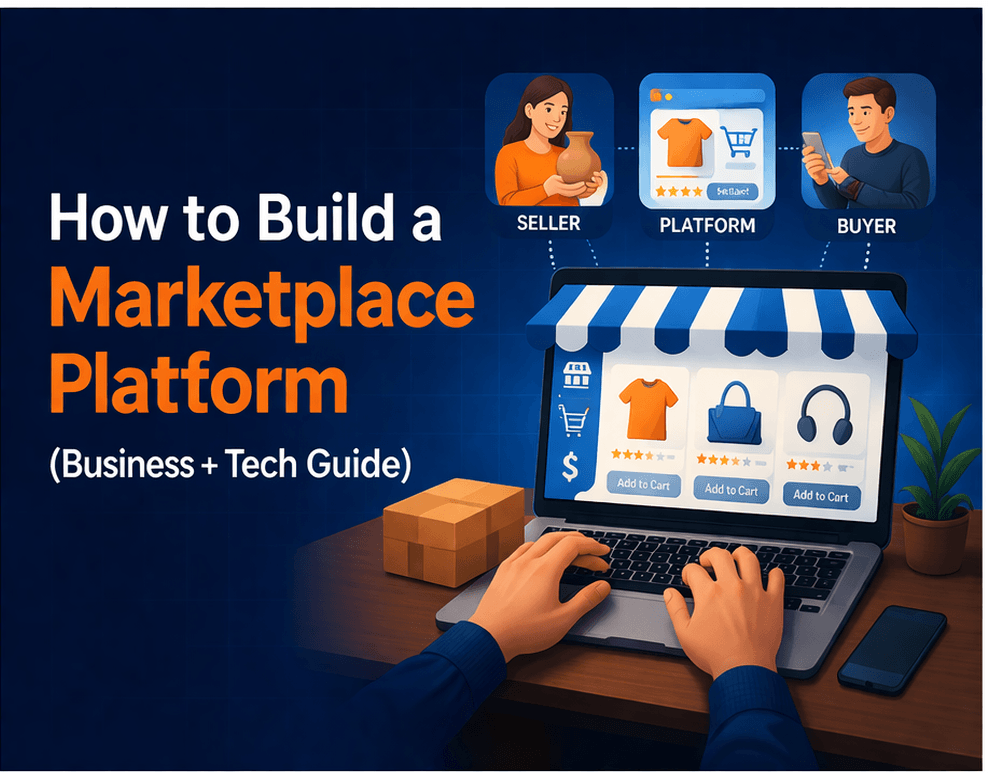
How to Build a Marketplace Platform (Business + Tech Guide)
Online marketplace platforms have become vital tools for businesses and entrepreneurs to effortlessly connect buyers and sellers in the digital age. If you want to create a niche marketplace or a large, scale platform, either way, you still need a well, thought, out strategy to succeed in the marketplace. This blog will serve as your guide through the business and technical sides of building a marketplace platform from the ground up.
Introduction to Marketplace Platforms
A marketplace platform is basically an online space where buyers and sellers get connected, and transactions are carried out. These platforms may be B2B (Business to Business), B2C (Business to Consumer), or C2C (Consumer to Consumer). The global popularity of online marketplaces like Amazon, eBay, and Airbnb has been the main reason for the rise of entrepreneurs and businesses who want to create such platforms in different sectors. The concept is simple; however, its implementation requires planning, development, and marketing strategies.
The creation of a triumphant marketplace platform goes beyond merely establishing a website. It entails profound comprehension of your target audience, picking the right niche, determining the technology stack, and constantly revising your strategies for the platform to be scalable and have sustained growth.
Types of Marketplace Platforms
Before you start working on your marketplace, you should first understand the types of marketplaces that exist. Here are the main categories:
B2C (Business to Consumer): A B2C marketplace is one where businesses sell products or services directly to consumers. Examples are e-commerce platforms such as Amazon and Alibaba.
B2B (Business to Business): B2B marketplaces are where businesses can buy from other businesses. It could be a business buying wholesale goods or services from another business. Platforms like Alibaba (for wholesale) and ThomasNet (for industrial products) are good examples.
C2C (Consumer to Consumer): C2C marketplaces are those where individuals can sell to other individuals. Examples of platforms like eBay, Craigslist, and Poshmark.
Niche Marketplaces: These marketplaces are for specific industries or types of products. Examples are platforms like Etsy for handmade goods or Carvana for used cars.
Each type of marketplace has its advantages and challenges. It is critical to pick the correct one based on your business objectives and target market.
Understanding the Marketplace Business Model
The business model of your marketplace will determine how you generate revenue and maintain growth. You can select from several models:
Commission-based: It is the most common model, where the platform gets a percentage of each transaction. Platforms like eBay and Airbnb utilize this model.
Subscription-based: Users (buyers or sellers) pay a recurring fee to access the platform’s features. LinkedIn and Patreon are great examples of subscription-based marketplaces.
Listing Fees: Sellers pay to list their products or services on the platform. This model is frequently adopted by sites such as eBay.
Freemium: The model offers basic features for free and charges for premium features, such as advanced analytics or priority listings.
Choosing the right business model is essential for building a sustainable marketplace. It should be in line with the needs of your target audience and your financial goals for the long term.
Steps to Build a Marketplace Platform
Building a marketplace platform is a complex task that necessitates the melding of business and technical strategies in a coherent manner. Here are the core steps that one must take:
Step 1: Define Your Niche and Target Audience.
Essentially, the first thing to do is to delineate what your marketplace would revolve around. Would you be targeting a large audience, or perhaps creating a niche platform for a particular industry or product? A well-defined niche will not only enable you to distinguish yourself from the multitude of competitors but also make it easier to target a specific group of users.
Step 2: Conduct Market Research and Competitor Analysis
Market research provides you with insights into the demands of your target audience and how your competitors meet those demands. It is crucial to recognize the uncharted territories in the market that your platform can occupy.
Step 3: Plan Your Features and Functionalities
The platform of your marketplace should be accompanied by a definite list of features. Examples of such features might be user registration, product listing, search filters, payment gateway integration, and review systems. Make a decision about which features are necessary for the MVP (Minimum Viable Product) and which ones can be implemented later.
Step 4: Choose the Right Tech Stack
Choosing the appropriate technology stack is a major factor that determines the success of your marketplace platform. A good tech stack makes your platform scalable, secure, and user-friendly from a maintenance perspective. For example, you can consider:
- Frontend: React, Angular, or Vue.js
- Backend: Node.js, Ruby on Rails, Django, or Laravel
- Database: PostgreSQL, MySQL, or MongoDB Payment
- Gateways: Stripe, PayPal, or Square
Step 5: Develop the Platform
It is possible to commission a development team to create your marketplace from the ground up or to go with a marketplace, building platforms such as Sharetribe or Arcadier. With a custom build, you have the freedom to design a platform that meets your exact needs, but it usually takes longer to complete and is more expensive.
Key Features of a Marketplace Platform
To maintain a platform that is both user-friendly and capable of scaling, it is necessary to include the following features:
- User Registration and Profiles: Enable the creation and management of accounts by both buyers and sellers.
- Product Listings: An effective system for the generation, modification, and categorization of product listings.
- Search Functionality: An advanced search tool that permits users to filter products based on different parameters (example: price, category, ratings).
- Payment Gateway Integration: Methods of payment that are secure, such as credit cards, PayPal, or other local options.
- Ratings and Reviews System: To create a trustworthy environment and to thus motivate feedback from buyers and sellers.
- Admin Panel: An all-inclusive dashboard that enables you to manage users, transactions, and platform settings.
- Security Features: SSL certificates, two-factor authentication, and data encryption to ensure the safety of user information.
Choosing the Right Technology for Your Marketplace
The correct technology will level up the functionality, growth, and security of the business. These are the main factors to hear out:
- Scalability: After your marketplace is huge, your tech stack has to be capable of dealing with increasing traffic and transactions. It is a good idea to use cloud hosting services like AWS or Google Cloud for cost and efficient scalability.
- Performance: Find out what technologies will assure minimal page loading times and a smooth user experience. A content delivery network (CDN) can be used for fast content delivery.
- Security: With the use of encryption, secure sockets layer (SSL), and regulation observance (for example, GDPR), protect the users’ data.
- Maintenance and Updates: Make a choice of technologies that have a strong community and frequent updates so that your platform stays safe and up-to-date.
Designing a User-Friendly Marketplace Platform
User experience (UX) and user interface (UI) design are really important to the success of your marketplace platform. A design that is easy and intuitive will draw users and keep them. Here are some suggestions:
- Easy Navigation: Make sure that users are able to find what they want with as little effort as possible. Logical categorization of products or services and provision of search filters.
- Mobile Responsiveness: As more users are shopping through their smartphones, make sure that your platform is completely responsive on all devices.
- Simple Checkout Process: Reduce the number of steps that are necessary for purchasing a product. A simplified checkout process increases conversion rates.
How to Monetize Your Marketplace Platform
You can monetize your marketplace platform in numerous ways:
- Commission Fees: Impose a percentage of the transaction amount for each deal.
- Subscription Fees: Provide subscription plans for sellers, allowing them to list their products or access premium features.
- Listing Fees: Impose a flat fee for listing products or services in the marketplace.
- Advertising: Provide advertising space to sellers or third-party companies that want to reach your audience.
Testing and Launching Your Marketplace Platform
Thoroughly testing your marketplace prior to a launch is an absolute must if you want to make sure it functions properly. Some of the major areas to look at are:
- Functional Testing: Verify that all features (for example, search, checkout, and payments) perform as expected.
- Usability Testing: Evaluate the user experience to confirm that it is intuitive and effortless.
- Security Testing: Secure your platform against potential threats by carrying out security audits.
Once the testing phase is over, get your launch plan ready. Trying out your product with a limited user base is one of the best ways to find issues before making the product accessible to the public.
Marketing Strategies to Grow Your Marketplace Platform
Effective marketing strategies are essential to platform growth. Some of these strategies are:
SEO and Content Marketing: Make your platform attractive to search engines by using keywords such as “build a marketplace” and “marketplace platform development.”
Social Media Marketing: Interact with customers through social media and advertise your marketplace.
Paid Advertising: Pay for ads on Google, Facebook, or Instagram to get new customers.
Influencer Marketing: Work with influencers who will promote your marketplace to more people.
Challenges in Building and Scaling a Marketplace
Building and scaling a marketplace inherently involves a distinct set of challenges, which are as follows:
- User Acquisition: The task of attracting both buyers and sellers might prove to be challenging, more so during the initial stages.
- Liquidity: The crux of a thriving marketplace lies in having a sufficient number of buyers and sellers to facilitate transactions.
- Trust and Security: The need for users to entrust your platform with their transactions and data calls for the implementation of robust security measures and user protection policies.
Conclusion
Creating a marketplace platform is a multi-faceted project that, if done right, will bring great business success and require sound business planning, user-focused design, and technology that can be scaled up. No matter if you are developing a B2C, B2B, or C2C marketplace, knowing your audience, picking the features wisely, and implementing the latest technologies will pave the way to your platform’s longevity. When all the pieces fit together, you have the power to build a thriving marketplace that meets the needs of both buyers and sellers, and at the same time brings you continuous revenue.
Frequently Asked Questions (FAQs)
A marketplace platform is fraught with difficulties in the areas of user acquisition, managing liquidity (i.e., making sure there are an equal number of buyers and sellers), and trust/security. Besides that, the decision on the suitable business model, the right technology stack, and providing a smooth user experience are indispensable factors that need to be thought through and implemented properly.
Monetizing your marketplace platform can be done in several ways:
Commission Fees: You can take a percentage of each transaction that occurs between the buyers and the sellers.
Subscription Fees: You can charge sellers a recurring fee that allows them to list their products or access premium features.
Listing Fees: You can charge sellers a fee when they list their products or services.
Advertising: You can offer advertising space to sellers or third-party advertisers that are looking to reach your marketplace audience.
To ensure both scalability and security, it is advisable to opt for a technology stack that is flexible and resilient. This is essential in accommodating an increase in user traffic and transactions over time. Additionally, cloud hosting services such as AWS or Google Cloud enable you to scale your infrastructure without any hassle. Concerning security, there should be a concerted effort to have SSL certificates, data encryption, two-factor authentication, and adherence to standards like GDPR in place to ensure that user data and transactions are secure. It is also a good practice to keep your platform updated and patched with the latest security fixes.