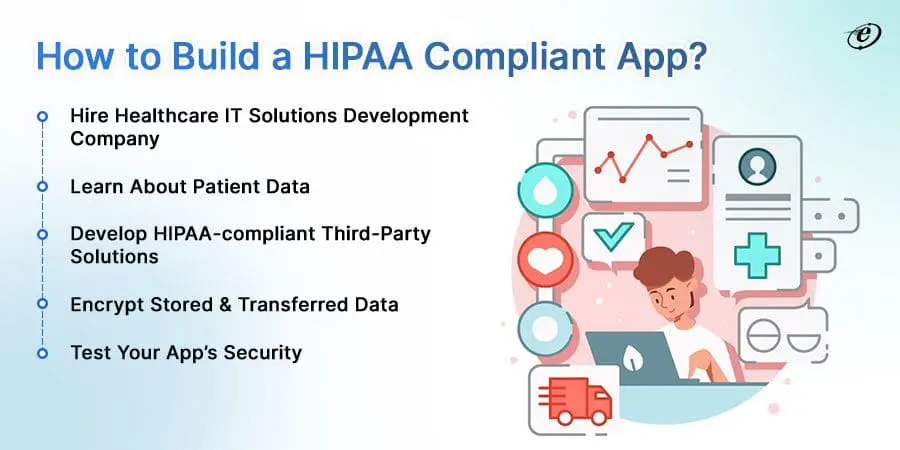
How to Build a HIPAA-Compliant Mobile App
Healthcare apps are becoming arguably the most influential patient care instruments in the healthcare sector within the shortest time possible. Consequently, the new wave of app-based healthcare solutions has made it very easy for patients to facilitate the completion of tasks such as appointment booking, health record management, or telemedicine services acquisition. Given that healthcare data is of utmost privacy, such apps need to conform to the Health Insurance Portability and Accountability Act (HIPAA) to be reliable at all.
In this blog, we will go through the essential stages of developing a HIPAA-compliant mobile app, thus making your healthcare app secure, private, and in compliance with the law.
Introduction
It is quite a challenge for healthcare app developers to create a mobile app that complies with HIPAA regulations. HIPAA is a legislation that guarantees the security of healthcare data, making sure that it is confidential, private, and safe, particularly when it is shared via mobile apps.
If you are a healthcare provider, developer, or business owner, it is still imperative for you to comprehend the meaning of HIPAA compliance before you can come up with an app that will be able to protect the users’ personal health information (PHI). This manual will assist you in understanding the complex structure of HIPAA and also serve as a roadmap to the best practices in app development that lead to compliance with regulations in the healthcare sector.
What is HIPAA, and Why is It Important?
HIPAA, or the Health Insurance Portability and Accountability Act, is a U.S. law that is aimed at keeping patient information confidential. The main purpose of the act is to make sure that Personal Health Information (PHI) is kept secure from any kind of unauthorized access or breach. The HIPAA standards are the laws that healthcare providers, insurers, and their business associates need to follow in handling, storing, and transmitting PHI.
To developers, HIPAA compliance should be considered a must when their app is dealing with PHI in any way, such as data storage, processing, or transmission. Otherwise, the offenders may be heavily penalized with a large amount of money, and their good name may be put at risk. So, it is very important for developers to install the correct security features in the application, both at the level of the device and the functionality, to be able to steer clear of any kind of violation.
Key Features of a HIPAA-Compliant Mobile App
To ensure that a mobile app is compliant with HIPAA regulations, it is necessary to incorporate several features that guarantee the protection and privacy of the data:
Data Encryption (In Transit and At Rest): Encryption should be applied to all data, particularly PHI, both when the data is being transmitted and when it is stored on devices or servers. The main purpose of this is to ensure that the data remains unintelligible even if it is intercepted or accessed without authorization.
Secure Login and User Authentication: HIPAA mandates that apps must take robust authentication measures to be implemented, for example, multi-factor authentication (MFA), in order to be certain that only authorized users can have access to sensitive health data.
Audit Trails and Logging: Keeping very detailed records of who accessed the data and at what time is an indispensable part of compliance with HIPAA. Such audit trails support the supervision of user activity and the recognition of the possible occurrence of security breaches.
Understanding PHI and Its Importance in Mobile App Development
PHI means Protected Health Information and is any personal health data that can be traced back to an individual. It covers medical records, treatment history, lab results, and even prescription details. If a mobile app is to follow the HIPAA rules, it should be the app that keeps the PHI data safe at all times.
Keeping PHI safe is the priority that cannot be emphasized enough. Those who provide health care and developers of apps are obliged to make sure that confidential patient information is stored safely, shared with only those who are authorized, and accessed in compliance with the very strict rules of HIPAA.
Steps to Ensure HIPAA Compliance in Mobile App Development
Developing a HIPAA-compliant mobile app requires a lot of thought and execution of the plan accordingly. These are the steps that you should follow to make sure of compliance:
Conduct a Risk Analysis: Take the risk assessment of the PHI in your application as the first step. This should include an evaluation of the storage, transmission, and access methods of the data. Knowing possible loopholes is the main thing to make sure of compliance.
Implement Technical Safeguards: Make provisions for security in your app, like encryption, secure communication protocols (For example, HTTPS), and firewalls to protect the data that is on its way and at rest. Be sure that sensitive data is not stored unnecessarily or for a long time.
Design Considerations: The user interface (UI) and user experience (UX) should be aimed at security. Data fields that contain PHI must be safe, and access should be limited to authorized users only.
Best Practices for HIPAA-Compliant Healthcare App Development
If you are creating a healthcare app, it is highly advisable that you practice how to remain HIPAA compliant and be sure about the security of the app.
Partner with Trusted Cloud Service Providers: Cloud services that comply with HIPAA are very crucial in securing healthcare data management. Select cloud providers that comply with HIPAA and are able to provide features such as data encryption and access control.
Regular Software Updates and Patch Management: Update the app’s software regularly to fix security vulnerabilities. Continual updates and security patch installations will keep you safe against the new threats.
Data Access Control and User Permissions: Do not extend the access of sensitive PHI to anybody except authorized personnel. Have detailed user permissions and role-based access control implemented to restrict the access of data viewing or modification to certain users only.
HIPAA Compliance Testing and Auditing for Mobile Apps
Testing and auditing are essential parts of the HIPAA compliance process. Developers must continuously test their applications to uncover security weaknesses and verify that the app complies with all HIPAA requirements.
Compliance Testing: Frequently perform penetration tests to locate and rectify security vulnerabilities. Also, verify the app’s encryption, authentication methods, and general data security measures.
Healthcare Apps Auditing: Employ instruments to scrutinize the app’s performance concerning HIPAA regulations. Auditing should encompass the examination of access logs, user authentication methods, and encryption protocols to confirm compliance.
Common Mistakes to Avoid When Building a HIPAA-Compliant Mobile App
While constructing a HIPAA-compliant mobile app, developers must refrain from several common mistakes:
Oversights in Data Protection: Not putting in strong enough encryption or ignoring the securing of data access can result in a situation that is not compliant with the law. Make sure that PHI is always encrypted and kept in a secure place.
Not Educating Employees about HIPAA: Developers, healthcare providers, and employees should all be trained in HIPAA regulations and their application in the field of app development and data management.
Necessity for Regular Audits: Compliance cannot be regarded as a one-time effort. It is necessary to carry out regular audits and make updates to keep the standards of HIPAA over time.
Case Study: A Successful HIPAA-Compliant Mobile App
We can take an example of a healthcare app that went through the process successfully and got HIPAA compliance.
For instance, a widely used mobile app for telemedicine services has all the essential features for compliance with the HIPAA regulations. The app encrypts the data while it is being sent, imposes multi-factor authentication for users, and keeps very detailed audit logs to check who has access to the data.
The achievement of this application emphasizes how important it is to follow HIPAA requirements. By making security and privacy their top priority, the app became a safe place for users and healthcare providers and, therefore, gained their trust.
Conclusion
It is a must-have piece of work for a person in the healthcare sector to build a mobile app that conforms to HIPAA requirements. Compliance not only serves as a shield for patient data, but it is also the guarantee of an app’s survival and popularity in a very regulated market. Developers can create secure, trustworthy, and HIPAA-compliant apps by taking the steps in this guide one after another.
In essence, the implementation of strong security features, deliberate planning, and unceasing watchfulness is what makes a healthcare app safe in terms of sensitive patient information and healthy in terms of trust. If you develop a mobile app that is compliant with HIPAA regulations, you are not only making sure that you adhere to the law, but also giving a great benefit to the users who depend on your app for safely handling their health data.
Frequently Asked Questions (FAQs)
HIPAA (Health Insurance Portability and Accountability Act) is a legislation in the United States that aims to safeguard sensitive patient information. In case a mobile app development team wishes to include an app that manages PHI (Protected Health Information), then the said app must comply with HIPAA regulations. It is the requirement that patient data be secured, kept confidential, and safeguarded against unauthorized access, thus being very important in trust retention and in warding off law sanctions.
Developers planning a mobile app that will contain health info must adhere to the Health Insurance Portability and Accountability Act (HIPAA) regulations and implement some security measures, such as data encryption methods (for data in transit or at rest), secure login, and user authentication protocols, as well as audit trails, which are used to check who had access to sensitive data. Besides that, they can fulfill the required HIPAA regulations by cooperating with reliable cloud service providers and performing constant risk evaluations.
If you fail to create a mobile app that is compliant with HIPAA regulations, you may experience a series of very negative consequences. Such consequences include substantial monetary penalties, lawsuits, and loss of your image and reputation. Infringements may be minimal or major, involving, in the latter case, the leaking of data which can be harmful to both your company and patients. Making sure that you comply with all provisions of the regulation is the law; however, it also takes you one step closer to protecting confidential patient data.