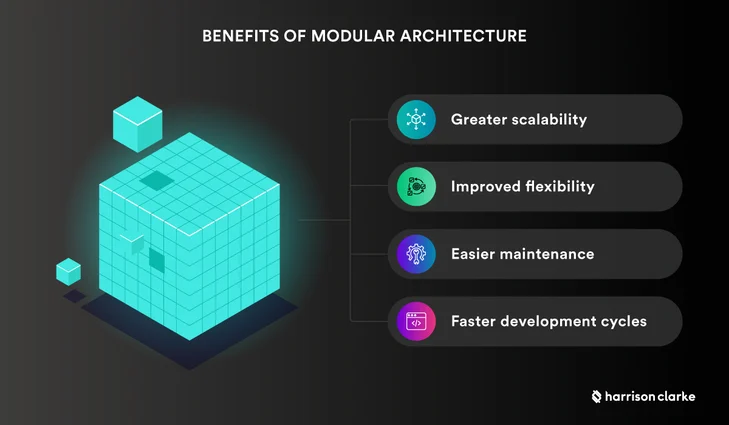
The Benefits of Using a Modular Architecture for Your Software
The pace at which software development has gone from being a manual process to full automation, one of the most influential improvements in modern development practices is modular architecture. As software systems grow increasingly complex, there is an ever-increasing demand for a structured yet flexible approach to design. Modular architecture presents developers with an ideal solution, enabling them to craft systems that are scalable, maintainable, and efficient. In this blog, we will discuss the various benefits of modular architecture and how it is capable of transforming your way of constructing modular applications.
What is Modular Architecture in Software Development?
In software development, modular architecture means that a particular design approach views a system as being divided into smaller, independent modules or components. Each of these modules is responsible for a certain functionality and communicates with other modules using well-defined interfaces. Such a modular design allows the teams to work simultaneously on different components of the overall system, thus making the latter more flexible and easier to maintain.
Why Modular Architecture Matters in Modern Software Development
With the increasing complexity of software, flexibility and structure are crucial to consider. Modular architecture allows developers to define systems that can be adapted to changing requirements. It makes the solution more scalable, enables faster development, and strengthens teamwork. Besides, with the growing demand for developing modular applications, adopting a modular approach will keep your software future-proof and enable it to evolve with time.
Understanding Modular Architecture
The Concept of Modular Design
Modular design is the essence of modular architecture, wherein a very large system needs to be reduced to smaller, manageable pieces. Each module can be independently developed, tested, and deployed; it gives developers the ability to work on specific functionalities without having to deal with the entire system.
Key Principles of Modular Architecture
- Encapsulation: Each module conceals its internal workings, revealing only necessary information through well-defined interfaces.
- Interoperability: Modules can communicate with each other through standardized interfaces, allowing them to interact seamlessly.
- Reusability: Modules can be reused across different projects, saving development time by reducing the chances of errors.
- Independent: Each module can be built, updated, tested, or deleted independently, without relying on others, which provides flexibility for software development.
How Modular Architecture Differs from Monolithic Architecture
In a monolithic architecture, the whole application is developed as a single unit, tightly coupled. While this may be feasible in small applications, it turns out to be unwieldy in growing systems. Modular architecture, on the other hand, fosters the path toward a more flexible and scalable approach, whereby the system is segmented into smaller, independent units that can evolve independently of each other.
Benefits of Using Modular Architecture
Improved Scalability
One of the key advantages of modular software architecture is scalability. As your application grows and demands increase, individual modules can be scaled independently based on need.
Ability to Independently Scale Modules
Rather than scaling the whole system, you can focus on those specific modules that need more resources. Such selectivity in scaling thus ensures better resource utilization and, consequently, an efficient system.
Handling Growing Demands Efficiently
What makes modular systems great is that you can simply add new modules or update existing ones without disrupting the whole system. It becomes easier to scale out to meet growing user demand and more traffic.
Improved Maintainability
As the system grows larger and more complex, maintenance of the application becomes difficult. Modular architecture greatly helps in solving this challenge by simplifying the process of updates and bug fixing.
Simplified Updates and Bug Fixes
Changes can be made in individual modules without affecting the entire application in modular systems; therefore, the introduction of bugs into other areas of the system is minimized. Also, with modular software architecture, updates are rolled out to particular modules rather than the whole system, thereby reducing downtime.
Faster Resolution Time
Problems are isolated in some modules, thus making debugging easier and faster. A developer has to target the problematic module, determine the source of the problem, and fix it without worrying about other parts of the system.
Improved Collaboration and Speed of Development
With a modular architecture, different development teams can work on independent modules at the same time. This parallel development allows for quicker software delivery and better collaboration among teams.
Enabling Parallel Development
Because modules are independent, development teams can simultaneously work on different modules without waiting for others to finish their work. This parallel development approach helps in reducing the overall project timeline.
Improved Workflows and Collaboration Among Teams
Modular systems promote effective communication and interaction among teams because each team knows the module’s specific role and how that interacts with other parts of the system. Well-defined module boundaries and clearly specified interfaces make interaction easy in a large-scale project.
Flexibility and Customization
A modular architecture allows for greater flexibility in adapting to new requirements or integrating new technologies.
Changing with New Requirements
This modularity allows you to add or modify modules as your business needs change without having to rewrite the entire application. Be it introducing new features or scaling certain components, modularity ensures that changes are quick and smooth.
Easier integration of third-party solutions
With modular software architecture, you can integrate third-party solutions with minimal interference to the overall system. Modules can be designed to interact with external services through standardized APIs, making integration easier and quicker.
Cost Efficiency
This can lead to significant savings in the cost of both developing and maintaining modular applications.
Reducing Development and Maintenance Costs
Since modules are reusable and independent, duplication of efforts across various parts of an application can be avoided. Updates or bug fixes are less time-consuming, thereby reducing the overall cost of maintenance.
Reusability of Code
Modularity in architecture gives the added advantage of reusing your code across projects, resulting in huge cost savings for future developments. The reuse of components reduces development time and offers consistency in applications.
Improved testability and debugging
Testing and debugging are crucial parts of software development, and modular architecture makes them far more manageable.
Isolated Testing of Individual Modules
In a modular system, you’re able to test each module independently. The isolation allows for more precise testing and ensures bugs are caught earlier on in the development process.
Faster Bug Identification and Fixes
It is easier to identify bugs in modular software architecture since they are confined to one module. It allows the developers to work on the faulty module without the complexity of dealing with the whole system.
Modular Architecture and the Cloud
Cloud-Native Architectures and Modularity
In fact, the advent of cloud computing has made modular architecture even more relevant. Cloud-native applications are designed to take full advantage of modularity, enabling them to scale up or down dynamically as demand requires.
Benefits of Modularity in Microservices and Serverless Environments
Both microservices and serverless architectures are based on the concept of modularity. Microservices break down an application into small parts, with each part responsible for a specific function, while serverless computing enables developers to execute code modularly without having to care about infrastructure. Both approaches benefit from the flexibility and scalability that modular architecture provides.
Case Studies of Cloud-Based Modular Software
Companies like Netflix, Amazon, and Spotify build their cloud-based systems with modular software architecture to provide scalable and resilient applications with high performance. These companies depend on modularity as an enabler for the rapid deployment of updates, handling millions of users, and seamless integration of new features.
Challenges of Modular Architecture
While there is great support from many sides for modular architecture, it also produces its own set of challenges.
Complexity in Initial Design
The design of a modular system requires judicious planning to define module boundaries, interfaces, and communications protocols. Poorly considered design decisions result in highly interconnected modules that defeat the purpose of modularity.
Potential for Module Overhead
While modularity offers flexibility, it can inherently add overhead, especially when many modules have to deal with one another. Keeping up with the interactions between modules requires special care to maintain performance.
Managing Dependencies Between Modules
Managing dependencies becomes complex as the number of modules increases. For instance, it requires developers to make sure interaction between modules is properly set and to avoid some circular dependencies that may complicate maintenance updates.
Best Practices for Implementing Modular Architecture
The best thing is to develop a modular software architecture by following the best practices for its implementation:
- Effective Modularization: It is important to modularize your system based on functionality, and every module should have a clear and specific responsibility.
- Define Clear Boundaries and Interfaces: Establish clearly defined interfaces for each module, ensuring smooth communication with minimum dependencies.
- Ensuring Proper Communication Between Modules: Employ standardized communication protocols like REST APIs or message queues to facilitate interaction between modules.
- Version Control and Dependency Management: Maintain module versioning and handle dependencies in a way that avoids conflicts and ensures compatibility within the system.
Modular Architecture vs. Monolithic Architecture: A Comparison
Key Differences
- Modular Architecture: It provides the partitioning of systems into independent modules, offers flexibility, scalability, and easy maintenance.
- Monolithic Architecture: The system is built as a single unit, which, over time, may not scale and become difficult to maintain.
When to Choose Modular Over Monolithic
Remember, you should go for modular software architecture if you anticipate that your system should grow or develop over time, be highly scalable, or be flexible and maintainable. On the other hand, monolithic architecture can suit smaller and simpler applications.
Pros and Cons of Each Approach
Each architecture has strengths and weaknesses. While modular architecture excels in flexibility, scalability, and maintainability, it requires careful design and management. Monolithic architecture is easier to develop but often proves difficult to scale and maintain over time.
The Future of Modular Architecture in Software Development
Emerging Trends and Technologies
With increased growth in software development, the importance of modular software architecture will continue to be paramount. Technologies like Kubernetes, serverless computing, and AI-driven development are expected to make modular systems even more scalable and flexible.
How Modularity Will Shape the Future of Software Design
The future of software development is modular. Given the increasing complexity of the applications, modularity will provide a foundation for scalable, maintainable, high-performance systems that are able to evolve with changing business needs.
Conclusion
In the end, modular software architecture provides a wide range of benefits-from improved scalability and maintainability to better collaboration and cost-effectiveness. By embracing modular approaches, developers can build flexible, adaptive systems that can manage the pace of modern software development. Be it large-scale enterprise applications or smaller, dynamic systems, building modular applications stands to future-proof your software by keeping it scalable, maintainable, and competitive in an ever-evolving landscape.
Frequently Asked Questions (FAQs)
Modular architecture is a design approach that breaks down a software system into smaller, independent modules, each responsible for a specific function. These modules interact through well-defined interfaces, making the system more flexible, scalable, and easier to maintain.
The key benefits of modular architecture include improved scalability (independent scaling of modules), enhanced maintainability (easier updates and bug fixes), better collaboration (parallel development), and cost efficiency (reuse of modules and reduced maintenance costs).
In modular architecture, the system is divided into independent, self-contained modules, making it easier to scale, maintain, and update. Monolithic architecture, on the other hand, builds the system as a single, tightly integrated unit, which can become difficult to scale and maintain as it grows.