Why Most MVPs Fail And How to Build One That Actually Succeeds
Within the fast-moving world of digital products, the Minimum Viable Product has become the go-to approach for startups, founders, and even large enterprises alike. The promise is simple: build the smallest version of your product, test it with real users, and iterate your way to success without spending months or millions on full development.
Yet despite this smart approach, most MVPs still fail.
Founders across the industry create MVPs with fanfare, only to find that nobody wants to use the product, the core value does not resonate, or there is not enough of a feedback loop to help iteratively improve. The real question, therefore, is:
If MVPs are a means of reducing risk, why do so many still fail?
And, more importantly, how do you build one that actually succeeds?
This blog will break down the major reasons why MVPs miss the mark, the principles at the foundation of any winning MVP development strategy, and the step-by-step process to create an MVP that evolves into a scalable product, rather than a dead-end path.
The Real Purpose of an MVP
Most founders misunderstand what an MVP truly is. They think it’s a half-baked product, a prototype, or a cheap version of the final idea. In reality, an MVP is a learning tool.
Its purpose is not to launch, its purpose is to learn.
A well-constructed MVP allows you to:
- Validate the real-world demand for your product
- Understand user behavior
- Identify what matters to users (and what doesn’t)
- Save months of superfluous development
- Reduce business and financial risk
A successful MVP does not have to be perfect; rather, it needs to deliver one core value really well.
But despite these obvious advantages, many founders get it wrong-and that’s where the failures begin.
What an MVP Really Is (And What It’s Not)
Before developing an effective MVP development strategy, it is important to understand what constitutes an MVP—and what doesn’t.
An MVP is:
- The most basic version of your product
- Designed to test assumptions
- Focused on ONE core user problem
- Quick to build, quick to test
- User-driven and data-backed
An MVP IS NOT:
- A low-quality product
- A full-featured version of your idea
- A complete solution
- A fully UI/UX polished application
- Anything built without any research or hypothesis
Confusing these definitions is one of the major reasons why MVPs fail. Founders often overbuild or underbuild; both extremes destroy clarity and learning.
Common Reasons Why Most MVPs Fail
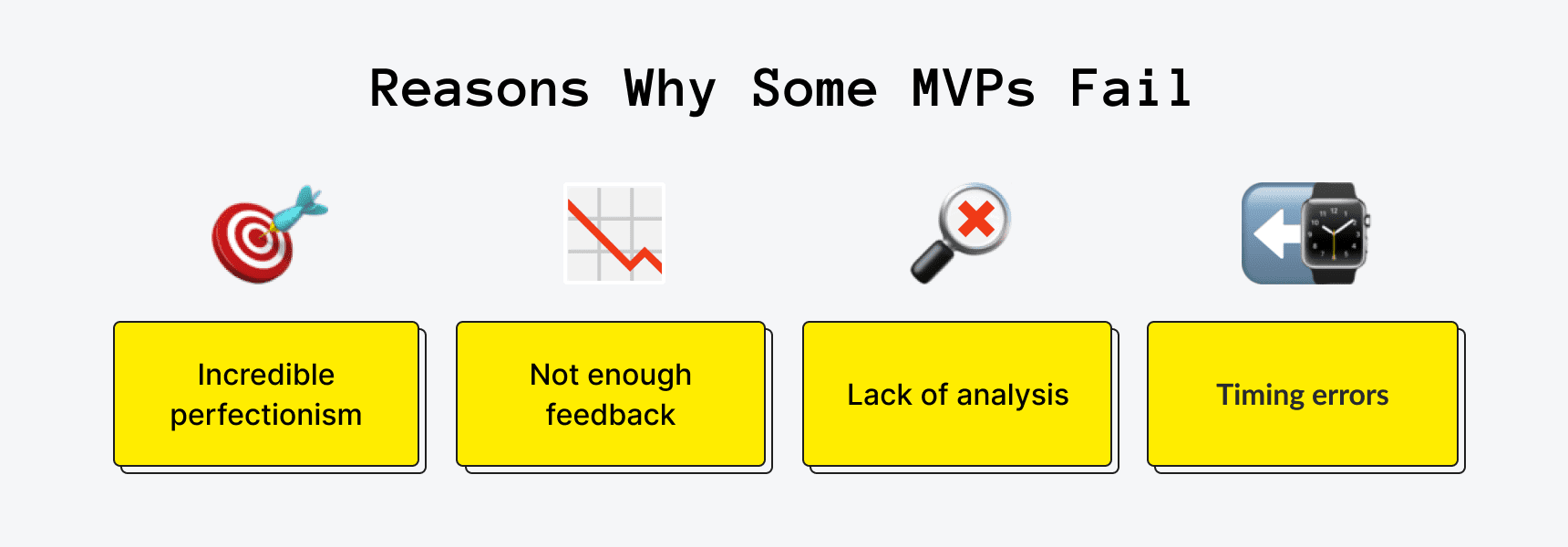
Every failed MVP might look different on the surface, but the underlying reasons are surprisingly consistent. Here are some major factors.
Misconception about the Target Audience
Many founders build products for an audience that doesn’t exist, or they misunderstand what the real audience wants.
Common mistakes include:
- Making assumptions instead of research
- Building a product based only on the personal frustration of the founder.
- Solutionizing before problemizing
- Not interviewing potential users
If you don’t know your users, the MVP cannot succeed-period.
Building Too Many Features
Instead of building an MVP, founders often make an “MMF”, a Maximum Maybe Feature-set product.
This leads to:
- High development cost
- Long time to launch
- Unclear core value
- User confusion
An inflated MVP dilutes the focus of the product and slows down the learning cycle, thus leading to failure.
Poor Problem-Solution Fit
A shocking number of MVPs solve a problem that is:
- Users don’t care about
- Competitors have already solved it
- Doesn’t happen frequently enough
- It isn’t painful enough to switch from the existing alternatives
If the problem is weak, then even the best MVP development strategy won’t save the product.
No Clear Success Metrics
Founders often launch an MVP before defining:
- What does success look like?
- How will they measure user behavior?
- Which numbers count most?
You can’t understand whether users find the MVP valuable, or if you just wasted development time without metrics.
Weak User Testing and Feedback Loops
An MVP is designed to learn, rather than to launch simply
But many teams:
- Don’t collect enough feedback
- Ignore negative feedback
- Testing with the wrong users
- Fail to iterate based on feedback.
A launch with no feedback loop is a guess, and guesses are the quickest path to product failure.
Real-World Examples of Failed MVPs
Most companies do not publish their failed MVPs, but we can learn from the patterns of the industry.
Example 1 – Feature Overload
A travel startup created an MVP with too many features: a trip planner, hotel finder, currency converter, and chatbot. The users felt overwhelmed. No core value stood out, and thus the product completely failed.
Example 2 – No Proper Validation
A fitness app invested heavily in bespoke workout AI before testing whether users wanted such an automated coach in the first place. In fact, they preferred video-driven routines.
Example 3 – Wrong Audience Targeting
A parenting application was intended to target mothers of newborn babies, but in reality, the engaged audience turned out to be parents of children aged 4 to 10 years old. Wrong target audience = MVP fail.
These examples illustrate better why clarity, validation, and iteration are more important than clever ideas.
What Successful MVPs Do Differently
Successful products follow a pattern.
They validate the problem before building
They research, interview users, and identify the real pain points.
They choose ONE core value
Uber started with “book a ride through an app.”
Airbnb started with “rent your room to a traveler.
They test with real users early
They gather real insights, not assumptions.
They iterate fast
They continuously fix, refine, and improve.
They measure everything
They define metrics like retention, activation, and engagement, and use them to shape the roadmap.
Successful MVPs are built with discipline, not luck.
How to Build an MVP That Actually Succeeds
Here’s a step-by-step blueprint for creating an MVP that actually works, rooted in research, strategy, and user insights.
Verify a Problem Exists
Before you write one line of code, make sure:
- Is the problem real?
- Is it painful enough?
- Is there a solution from people now?
- Are they willing to pay for a better one?
Use interviews, surveys, competitor analysis, and market trends.
This forms the very basis of any effective MVP development strategy.
Identify Your Core Features Only
Choose only one primary feature that solves the core pain point.
Ask:
- What is the smallest thing we can build that still delivers value?
- If we remove this feature, does the MVP still work?
- Is this feature necessary for learning?
Your MVP should be lean, simple, and focused-nothing else.
Build Fast, Test Fast
Speed is your biggest advantage.
Utilize fast development tools like:
- No-code builders
- Low-code platforms
- Prebuilt UI kits
- Third-party APIs
- Rapid prototyping tools
Your goal is to learn, not to be perfect.
Use Data-Driven Iteration
Once it is launched, track:
- User onboarding behavior
- Retention
- Feature usage
- Drop-off points
- Feedback themes
Analyze:
- What users love
- What they overlook
- What they complain about
- What they expected but didn’t find
Then iterate based on data, not assumptions.
This is how an MVP grows into a real product.
Popular MVP Development Frameworks (Lean, Agile, Build-Measure-Learn)
Understanding the right frameworks will help you build your MVP strategically.
Lean Startup Methodology
The Lean MVP approach focuses on
- Waste elimination
- Fast validation
- Rapid iterations
- Measuring real customer behavior
This also perfectly aligns with modern product strategies.
Agile Development
Agile helps teams to:
- Build incrementally
- Adapt quickly
- Test continuously
- Collaborate effectively
It is ideal for MVPs in which the scope tends to change rather frequently.
Build-Measure-Learn Loop
The core cycle:
Build → Create a small feature
Measure → Track user data
Learn → Identify what to change
This loop actually repeats until the product attains clarity and fits perfectly.
Cost & Timeline: What to Expect When Building an MVP in 2025
The cost also varies based on complexity, feature list, tech stack, and team location. In the 2025 trends, we can see:
Typical Cost Range for MVP
$10,000 – $80,000 for simple apps
$80,000 – $200,000 for medium complexity
$200,000+: for advanced features or AI-based solutions
Typical MVP Timeline
4 to 12 weeks for simple MVPs
3 to 6 months for larger projects
Costs increase significantly if:
- You add too many features.
- You change direction mid-development
- You skip research and require redesigns
- You do not clearly define the scope.
A clear MVP development strategy guarantees cost control and faster delivery.
Best Practices for Launching & Scaling Your MVP
To turn your MVP into a successful product:
Begin with a Soft Launch
Launch to a small group of real users to get feedback and refine before going public.
Collect Both Quantitative and Qualitative Feedback
Quantitative: analytics, metrics, heatmaps
Qualitative: interviews, open-ended surveys
Both types of data make for strong insights.
Focus on the Right Features in Next Iteration
Not all requests will matter. Prioritize based on:
- User value
- Business Value
- Effort needed
- Market demand
This is the core of scaling an MVP responsibly.
Keep Costs Low Until Product-Market Fit
Don’t overinvest before you confirm users actually want your product.
Develop a Growth Strategy Early
Include:
- Onboarding optimization
- Referral systems
- Retention strategies
- User education
- Community involvement
Products are successful because users find value in them and continue to return.
Conclusion
Most MVPs fail, not because the ideas are bad, but because of poor execution, wrong assumptions, and lack of clarity. When founders misunderstand their target audience, add unnecessary features, or ignore real user behavior, the product eventually falls short. On the other hand, a successful MVP is built through a strategic and evidence-driven approach. It starts with problem validation, focuses on delivering one strong core value, and stresses learning from real-world user behavior. You will reduce risks and make smarter decisions by iterating faster and following a clear strategy for MVP development. If you build with intention, discipline, and research, then you don’t just launch an MVP-you create the foundation for a scalable and profitable business.
Frequently Asked Questions (FAQs)
Most MVPs fail because founders skip research, misunderstand the audience, build too many features, or do not validate their assumptions. Poor feedback loops and unclear success metrics make the problem even worse.
You have product-market fit when users consistently return, recommend your product, and express clear satisfaction with it. Retention, engagement, and word-of-mouth are key indicators of success.
A typical MVP requires 4 to 12 weeks, depending on complexity, team size, and clarity of scope. If you spend months on your MVP, you’re likely overbuilding.